

Maybe you’re building a home or undertaking renovations. Perhaps you want a statement piece to set your home or business apart. Choosing the right material to breathe life into your dreams can keep you up at night. But it doesn’t have to.
In this guide, we answer the most common questions we get asked about the difference between iron and steel, and settle the age-old steel versus iron debate once and for all. Spoiler alert: we’re team wrought iron. We’re firm believers that wrought iron’s durability and versatility triumph over mass-produced steel products every day, and that opting for steel over wrought iron is a mistake we’ve seen people make too many times.
Steel versus iron – Comparison
Put simply, iron and steel are different metals. That means they have different properties that lend themselves to very different uses. They’re also made in completely different ways. Iron is a naturally occurring element, whereas steel is an alloy (or mixture) of iron and carbon. Wrought iron is also an alloy, but it has a significantly lower carbon content than steel, giving it a malleability that’s hard to match.
Manufacturing difference
Whether you’re looking for Stylish Security Screen Doors That Will Make An Entrance, or looking for Outdoor Fence Decoration Ideas To Transform Your Home, the way it’s made makes all the difference, and is what separates wrought iron and steel when it comes to strength, durability, beauty and longevity.
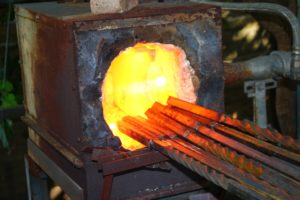
Wrought means ‘worked iron’. It’s a material whose story is romantically interwoven with blacksmiths, forges, hammers and anvils. If you’re thinking of the glow of hot iron fresh from the fire, the ring of the hammer as it’s pounded and persuaded into place and a highly skilled artisan blacksmith, you’re spot on.
Wrought iron is created by mixing liquid iron with slag in an environment designed to keep its carbon content low. It’s a finely tuned balancing act that takes years of training and dedication to master. That’s why it’s not uncommon for one skilled artisan to complete the whole process of manufacturing something from wrought iron from beginning to end. Too much carbon, and the iron becomes brittle and unmalleable. For example, cast iron has a higher carbon content than wrought iron. This makes it ideal for pouring into moulds, but it can’t be worked, shaped, stretched, or curved in the same way that wrought iron can be.
If you’re thinking about steel making, you should have a very different picture in mind: a large, offshore commercial foundry, dozens, if not hundreds, of workers, machines and robots and a rigid, production line process. That’s all very well if you want what everyone else wants: a one-size-fits-all, cookie-cutter solution.
Steel is the end product of a process that combines iron, carbon and other elements and compounds. Steels fall into four main sub-categories: carbon steel, alloy steel, tool steel and stainless steel. The end result depends on the manufacturing process and the elements added during that process. Steel was the end result of a search for cheaper, quicker ways to mass-produce building materials to feed the demands of a burgeoning building and construction industry towards the end of the 19th century.
Difference in appearance
Wrought iron has a distinctive ‘wood grain’ finish thanks to the inclusion of slag in its composition. Its malleability also makes it distinctive—it’s commonly worked into ornate, detailed and intricate pieces.
Where wrought iron has a beautiful dark lustre, steel has a distinctively industrial appearance. Steel is also commonly coated with paints to add to its durability (e.g. Colorbond). Unlike wrought iron, it’s much lighter in colour and far less malleable, meaning it’s commonly manufactured into simple, geometric designs.
Steel or wrought iron – which is better?
We might be a little biased, but we’re firm believers that wrought iron trumps steel every time. It’s practical, beautiful and timeless—perfect for custom wrought iron design ideas for modern Australian homes. No matter the current fads and trends, the built-in obsolescence and throwaway mentality of modern consumerism, there’s always a place for the bespoke, the individual and the beautiful. Here are three reasons we say you should choose wrought iron over steel every time:
- Longevity: If properly maintained, wrought iron will last for generations, making it a worthy investment. It’s much less susceptible to the type of corrosion that spells the end for inferior steel products. That’s particularly relevant in Queensland, where our humid climate and coastal living mean corrosion should be at the forefront of your mind when you’re choosing between steel and wrought iron.
- Strength and durability: Cost shouldn’t be the only factor when you’re making a decision between wrought iron and steel. There’s a huge variation in types and qualities of steel products, especially in a market flooded with cheap imports. With wrought iron, you get a consistently strong and durable product that’s well-placed to withstand sudden, heavy blows. It’s naturally more corrosion resistant than steel, making it ideal for fences, security doors and window grilles. One of the truly amazing properties of wrought iron is that it combines aesthetics with functionality, meaning you not only get a beautiful product, but one that will last a lifetime.
- Greater scope for expressing your individuality with wrought iron: There’s no scope for expressing your individuality with steel. However, the world’s your oyster with wrought iron. It can be worked into intricate designs, from the contemporary to the classical. If you can dream a design in wrought iron we can make it a reality for you. With wrought iron, you’re free to create a statement piece; be it a sweeping balustrade, a jaw-dropping piece of furniture, a gate that stops traffic or a fence that adds incredible street appeal and value to your property.
References
- Irish Iron ‘Wrought Iron vs Steel: The Key Differences’, Irish Iron blog, accessed on 23 May 2025
- Titus Steel (23 January 2024) ‘Difference between steel, cast iron and wrought iron’, Titus Steel blog, accessed on 23 May 2025